
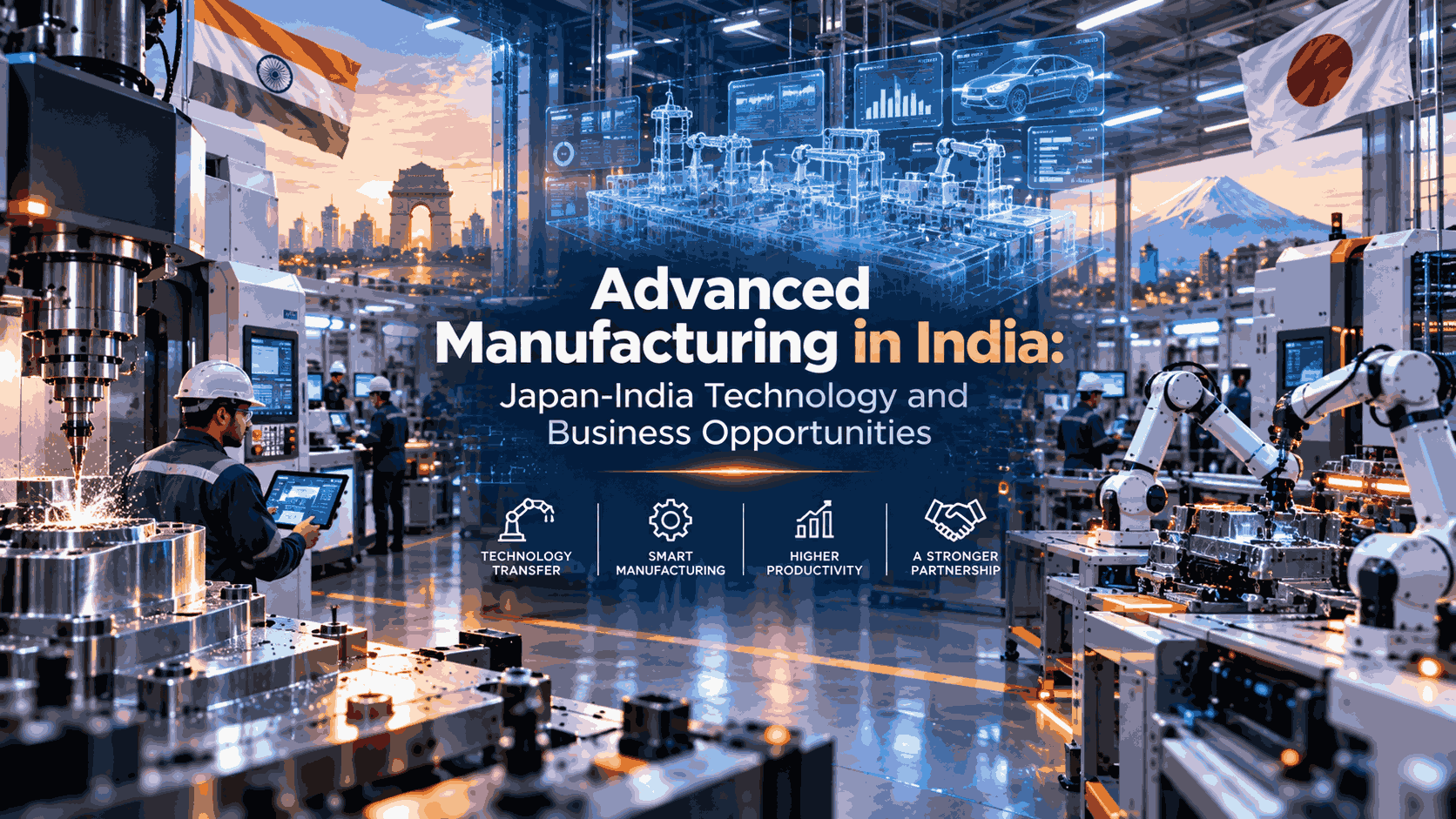
The manufacturing industry in India is shifting to a technology-based approach that relies on advanced manufacturing, Industry 4.0, robots and automation, artificial intelligence, precision engineering, and smart factories. These factors are providing opportunities for value-added manufacturing in India due to its huge industrial base and technological advancements. Moreover, the strengths of Japan in areas like precision manufacturing, robots, CNC, and factory automation can be utilized for Japan-India advanced manufacturing cooperation.
India's Growing Advanced Manufacturing Industry
Advanced manufacturing not only involves conventional manufacturing but involves incorporating digital and cutting-edge technologies in manufacturing processes. In India, advanced manufacturing is taking place in industries like automobile, electronics, semiconductors, aerospace, defence, energy, pharmaceuticals, and engineering.
India's advanced manufacturing environment today incorporates technologies like CNC machine tools, robotics, automation, industrial IoT, artificial intelligence, additive manufacturing, digital twin, testing and metrology. In 2026, the Government had identified areas of CNC machines, robotics, testing and metrology, and advanced additive manufacturing as important to develop domestic capabilities in India.
Why India Is Emerging as an Advanced Manufacturing Hub
India presents an excellent mix of its vast domestic market potential, manufacturing capacity, engineering prowess, and technology adoption. The focus of India on making its supply chains resilient and raising domestic value addition has further fuelled the investments in advanced manufacturing capabilities.
The Reimagining Manufacturing: India's Roadmap to Global Leadership in Advanced Manufacturing plan by NITI Aayog lists AI and machine learning, advanced materials, digital twins and robotics among other high-impact technologies that will transform India's manufacturing sector.
This, therefore, represents an opportunity ranging from increased manufacturing capacities to better accuracy, productivity, quality, and competitiveness.
Key Advanced Manufacturing Technologies in India
Robotics and Industrial Automation
Industrial robots, robot arms, collaborative robots, machine vision, and automated production lines can enhance productivity and safety in the work environment. Robotics and physical artificial intelligence are now increasingly being seen as key enablers of advanced manufacturing by Indian policymakers.
Artificial Intelligence and Machine Learning
AI can support predictive maintenance, quality inspection, process optimisation, production planning and real time decision making, enabling manufacturers to move towards more intelligent production systems.
Industrial IoT and Smart Manufacturing
Devices connected together through sensing, data analytics and industrial data platforms allow the industry to keep track of manufacturing activities as well as their machinery in real time.
CNC and Precision Manufacturing
CNC machine tools, advanced controllers, precision equipment and metrology are fundamental to high accuracy manufacturing. Strengthening these capabilities is a current priority in India's advanced manufacturing strategy.
Additive Manufacturing
3D and 4D printing can support rapid prototyping, customised components, complex geometries and advanced industrial applications. India's advanced manufacturing discussions are also focusing on materials, process qualification, testing and industrial scale up.
Digital Twins
Digital twins create virtual representations of products, machines or production systems, allowing manufacturers to simulate processes, identify problems and optimise operations before implementing changes on the factory floor.
Industry 4.0 and Smart Manufacturing in India
This industry combines automation, AI, IoT, robotics, analytics, and digitalization in order to create better connected and smarter manufacturing ecosystems.
There have been created four SAMARTH Centres by India's Ministry of Heavy Industries that will help develop the idea of Industry 4.0. The centers help in the development of Industry 4.0, digital manufacturing, robotics, autonomous and additive manufacturing, while other Industry 4.0 experience centers are being set up as well.
For manufacturers, this process may have a positive impact on productivity, quality, utilization of equipment, and flexibility.
Why Japan Matters to India's Advanced Manufacturing Industry
Japan is known to be a land of engineering excellence, robotics, CNC machine tools, factory automation, quality management, and advanced manufacturing. All of these could benefit from the scale of manufacturing in India along with its engineering talent pool and demands for high-tech manufacturing.
JIBB concentrates on connecting CNC manufacturers of Japan, robotics manufacturers, and precision tool manufacturers with manufacturing facilities in India.
This makes possible a number of technology collaborations, localizations, and investments into industry.
India-Japan Advanced Manufacturing Partnership
Indian and Japanese collaboration in manufacturing can go beyond traditional manufacturing into areas like robotics, automation, machine tools, precision manufacturing, Industry 4.0, research and development, technology transfer, manpower training and logistics. The collaboration is a symbiotic one, wherein Japan has the expertise in manufacturing and precision technologies, while India has the benefit of large-scale markets, manpower and manufacturing capacities.
Key Opportunities for Japanese Companies in India's Advanced Manufacturing Sector
CNC and Precision Manufacturing
Japanese companies can explore opportunities in CNC machine tools, controllers, precision equipment, tooling, metrology and specialised manufacturing systems.
Robotics and Factory Automation
Growing demand for automation creates opportunities for Japanese robotics, industrial automation and factory technology providers.
Smart Manufacturing Technologies
Industrial IoT, connected factories, manufacturing software, AI and digital production systems offer opportunities for technology partnerships and deployment.
Additive Manufacturing
Japanese expertise in advanced manufacturing processes, equipment and materials can support India's development of industrial additive manufacturing capabilities.
R&D and Technology Partnerships
Companies can also explore joint R&D, technology transfer, localisation, manufacturing partnerships and collaborations with Indian industrial and research institutions.
Opportunities for Indian Manufacturing Companies to Collaborate with Japan
The India-Japan partnership is a reciprocal one. The manufacturers of India can partner with those of Japan through technology collaboration, joint venture, research and development, manufacturing cooperation, robotics, automation, precise engineering and quality management systems.
This will enable the Indian companies to enhance their manufacturing competencies and become a part of the global supply chain.
Advanced Manufacturing Across Indian Industries
Advanced manufacturing technologies find applications in the areas of automotive and electric vehicles, electronics and semiconductors, aerospace and defence, pharmaceuticals and medical devices, renewable energy, and machine tools and engineering.
For instance, the defence industry has already been encouraging automation, artificial intelligence, robotics, additive manufacturing, digital twins, and smart materials as an element of advanced manufacturing.
Government Support for Advanced Manufacturing in India
Transformation of manufacturing in India has been possible through programs such as National Manufacturing Mission, Production Linked Incentives, Industry 4.0, R&D programs, and advanced manufacturing technology programs.
National Manufacturing Mission pays attention to making it easier and cheaper to do business, having a future-ready workforce, MSMEs, availability of technology and quality products.
Research and development and new technologies have been enhanced through programs like Research, Development and Innovation Fund and National Mission on Interdisciplinary Cyber Physical Systems.
Challenges in India's Advanced Manufacturing Transformation
Some of the challenges faced during the transformation include technological cost, need for skilled labour, technological uptake by MSMEs, localization of important machinery, testing and certification facilities, research and development, and security. The overcoming of these challenges will call for collaboration between industry and academia, technology alliances, special skills, and international cooperation.
How JIBB Supports Japan-India Advanced Manufacturing Collaboration
How JIBB could be of assistance to Japanese and Indian businesses to transition from exploring the market to doing business would involve market entry services, partner identification services, business matchmaking, government and institutional contacts, manufacturing collaborations, and technology collaborations.
Possible contacts could include CNC machines manufacturers, robotics firms, precision tools manufacturers, industrial manufacturers, technology firms, distributors, venture capital firms, and research and development institutes.
The Future of Advanced Manufacturing in India
The future of Indian manufacturing will increasingly involve AI powered factories, robotics, autonomous systems, digital twins, additive manufacturing, advanced materials, precision engineering and connected production.
India's ambition is not simply to manufacture at greater scale, but to develop stronger domestic capabilities in the technologies that underpin modern manufacturing. Japan's expertise can complement this transition by bringing precision, automation and industrial know how to India's expanding manufacturing ecosystem.
Frequently Asked Questions
What is advanced manufacturing?
Advanced manufacturing uses technologies such as robotics, AI, CNC systems, additive manufacturing, IoT and digital twins to make production more precise, efficient, flexible and intelligent.
What is advanced manufacturing in India?
Advanced manufacturing in India refers to the adoption and development of technologies including robotics, automation, AI, CNC machine tools, additive manufacturing and smart factory systems across industries.
What technologies are used in advanced manufacturing?
Major technologies include robotics, industrial automation, AI and machine learning, IoT, CNC machining, additive manufacturing, digital twins, advanced materials and testing and metrology systems.
Why is advanced manufacturing important for India?
It can help India improve productivity, precision, domestic value addition, technological capability and global manufacturing competitiveness while strengthening resilient supply chains.
What is Industry 4.0 in manufacturing?
Industry 4.0 refers to the integration of connected machines, automation, IoT, AI, robotics, data analytics and digital technologies to create smarter and more responsive manufacturing systems.
Why is Japan important to India's advanced manufacturing sector?
Japan has strong capabilities in precision engineering, robotics, CNC technologies, factory automation and quality management that can complement India's manufacturing scale and engineering talent.
What opportunities exist for Japanese manufacturing companies in India?
Opportunities include CNC machine tools, robotics, factory automation, precision equipment, smart manufacturing, additive manufacturing, R&D, technology partnerships and local manufacturing.
How can Indian companies collaborate with Japanese manufacturers?
Indian companies can explore joint ventures, technology partnerships, R&D, manufacturing collaborations, automation projects, technology transfer and Japanese business networks.
What government initiatives support advanced manufacturing in India?
Key initiatives include the National Manufacturing Mission, PLI schemes, Industry 4.0 programmes, advanced manufacturing technology initiatives and R&D programmes supporting emerging technologies.
How does JIBB support advanced manufacturing partnerships?
JIBB supports India-Japan business collaboration through market entry assistance, partner identification, business matching, institutional connections, manufacturing partnerships and technology collaboration.
India is building a more technology intensive manufacturing ecosystem driven by advanced manufacturing, Industry 4.0, robotics, AI, precision engineering and smart production. Japan's expertise in precision manufacturing and factory automation can complement India's market scale, talent and industrial capabilities.
Together, these strengths can create new opportunities across manufacturing, technology, R&D and supply chains.