
Introduction
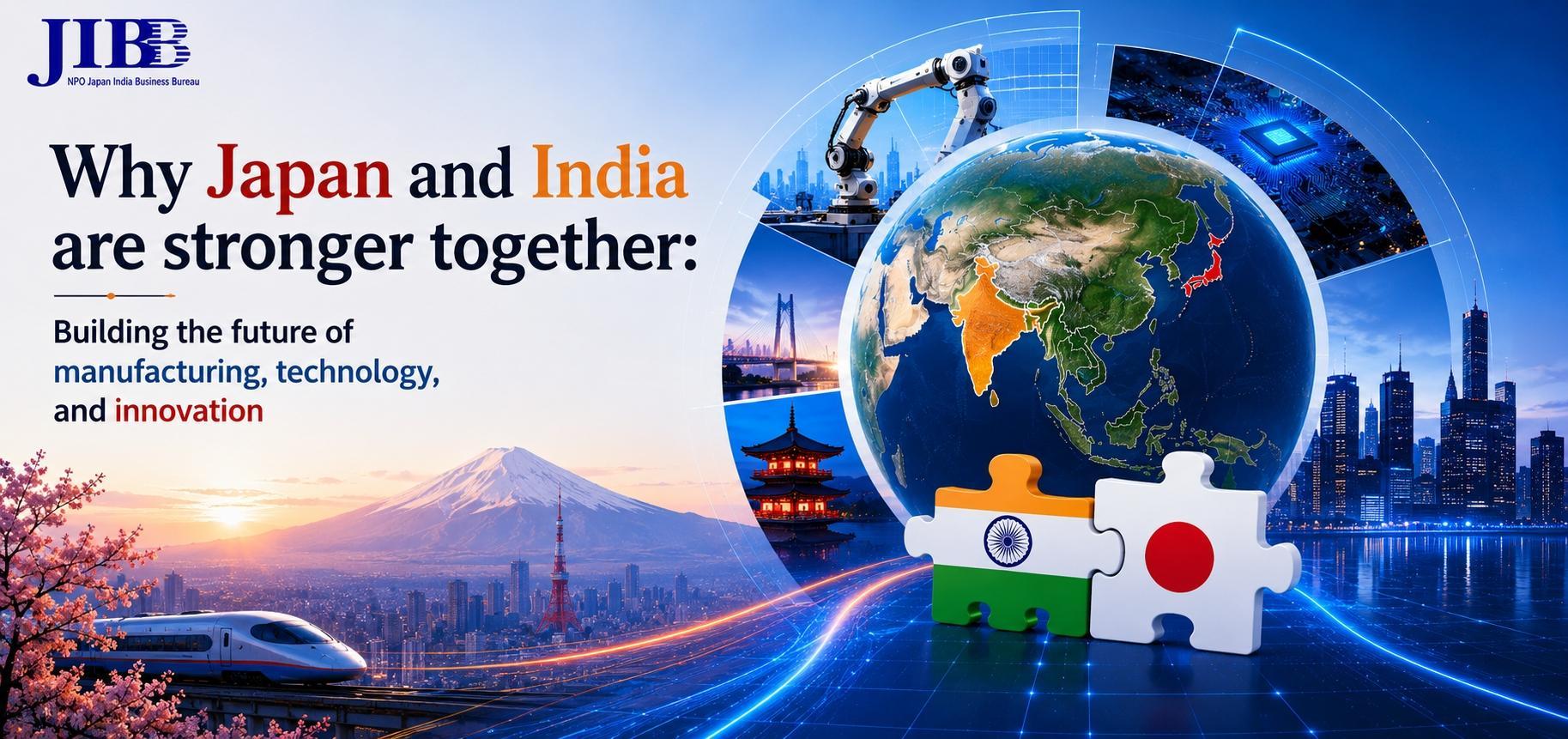
The partnership between Japan and India is entering a new phase, shaped less by diplomacy and more by structural economic needs and industrial priorities. Japan, known for its precision manufacturing and technological leadership, is facing long-term demographic challenges, including a shrinking workforce and rising production costs. India, on the other hand, is rapidly expanding its industrial capacity, supported by a young workforce, improving infrastructure, and strong policy support.
At the same time, global supply chains are undergoing major restructuring. Companies are increasingly adopting "China+1" strategies, pushing manufacturing and sourcing to more diversified and resilient locations. In this evolving environment, India and Japan are emerging as natural partners with complementary strengths in manufacturing, technology, and innovation.
This is no longer just a bilateral relationship. It is a strategic industrial alignment, marking the beginning of a new era of transformation in the Indo-Pacific.
1. Japan's Industrial Transition and Global Expansion Strategy
Japan has long been a global leader in high-quality manufacturing, precision engineering, and advanced industrial systems. However, domestic structural challenges are reshaping its long-term industrial strategy.
One of the most significant issues is an ageing population, which has led to a shrinking labour force. This creates pressure on manufacturing capacity and limits domestic scalability. At the same time, Japan faces relatively high production costs, making it increasingly difficult for companies to remain competitive in labour-intensive or large-scale manufacturing within the country.
As a result, Japanese industries are actively expanding their global footprint. The focus is shifting from domestic-centric production to building resilient and distributed manufacturing ecosystems across strategic international locations.
India has emerged as one of the most attractive destinations in this strategy due to its scale, political stability, and growing industrial base. Rather than being viewed as just an outsourcing hub, India is increasingly seen as a long-term partner for co-production and co-development.
2. India's Manufacturing Growth Story and Structural Advantage
India's manufacturing ecosystem has undergone a significant transformation over the past decade. Government-led initiatives such as "Make in India" and Production Linked Incentive (PLI) schemes have strengthened the country's position as a competitive global manufacturing destination.
A key advantage India holds is its demographic structure. With a large and young workforce, India offers both scale and long-term labour sustainability, which directly addresses one of Japan's biggest challenges.
Alongside this, India is rapidly improving its industrial infrastructure. The development of industrial corridors, logistics networks, and digital governance systems has made large-scale manufacturing more viable than ever before.
Additionally, India offers a strong cost advantage while also developing a growing base of engineers, technicians, and skilled professionals. This combination of cost efficiency and talent availability makes India highly attractive for advanced manufacturing operations.
For Japanese companies, India is no longer just a market. It is becoming a production base for global expansion.
3. Key Sectors Driving India–Japan Industrial Collaboration
The India–Japan partnership is particularly strong in sectors that are central to future global economic growth.
Semiconductors and Advanced Electronics
Semiconductors are critical to the global digital economy, powering everything from smartphones to artificial intelligence systems. Japan brings decades of leadership in semiconductor materials, precision equipment, and manufacturing processes. India is now building its presence in semiconductor assembly, testing, and design capabilities. We explore this dynamic deeply in India–Japan Semiconductor Partnership: Beyond Silicon. Together, both countries can contribute to strengthening global semiconductor supply chain resilience.
Automotive and Electric Mobility
Japan has a well-established automotive industry with global leadership in manufacturing quality and efficiency. As the world transitions towards electric mobility, collaboration opportunities are growing in EV components, battery technology, and sustainable transport systems. India's expanding domestic market further enhances the importance of this sector.
Electronics and Precision Manufacturing
The global shift in electronics manufacturing away from concentrated supply chains has created new opportunities for diversification. India is emerging as a strong hub for smartphone production, consumer electronics, and assembly operations, while Japan contributes advanced manufacturing systems and high-precision technologies.
These sectors are not isolated opportunities. They represent the foundation of future industrial collaboration between the two nations.
4. Innovation, Knowledge Exchange, and Ecosystem Development
Beyond manufacturing, the India–Japan relationship is increasingly defined by innovation and knowledge exchange. This includes collaboration in research and development, startup ecosystems, skill development, and industrial training programs.
Japan's strengths lie in process excellence, quality systems, and advanced engineering capabilities. India contributes scale, digital innovation, and a rapidly growing entrepreneurial ecosystem. When combined, these strengths create opportunities for joint development rather than traditional outsourcing relationships.
Institutions such as JIBS play a critical role in enabling this ecosystem by connecting businesses, facilitating dialogue, and supporting cross-border industrial partnerships. Key networking forums like the India-Japan Manufacturing Collaboration 2026 act as direct avenues for business matchmaking, leadership dialogue, and strategic partnership formation between Indian and Japanese manufacturers. These platforms help move the relationship from transactional trade to long-term strategic collaboration.
The future of this partnership will depend on how effectively both countries align innovation capabilities with industrial execution.
Conclusion
The India–Japan partnership is evolving into a strategically important industrial alliance. Japan's technological expertise and India's demographic strength and manufacturing expansion create a strong foundation for long-term collaboration in global markets.
As global supply chains continue to diversify and industries become more interconnected, the importance of this partnership will only increase. Together, India and Japan are not just participating in global manufacturing growth but are actively shaping its future direction.
The next question is not whether India and Japan will collaborate, but how far this partnership can go in reshaping global manufacturing over the next decade.