
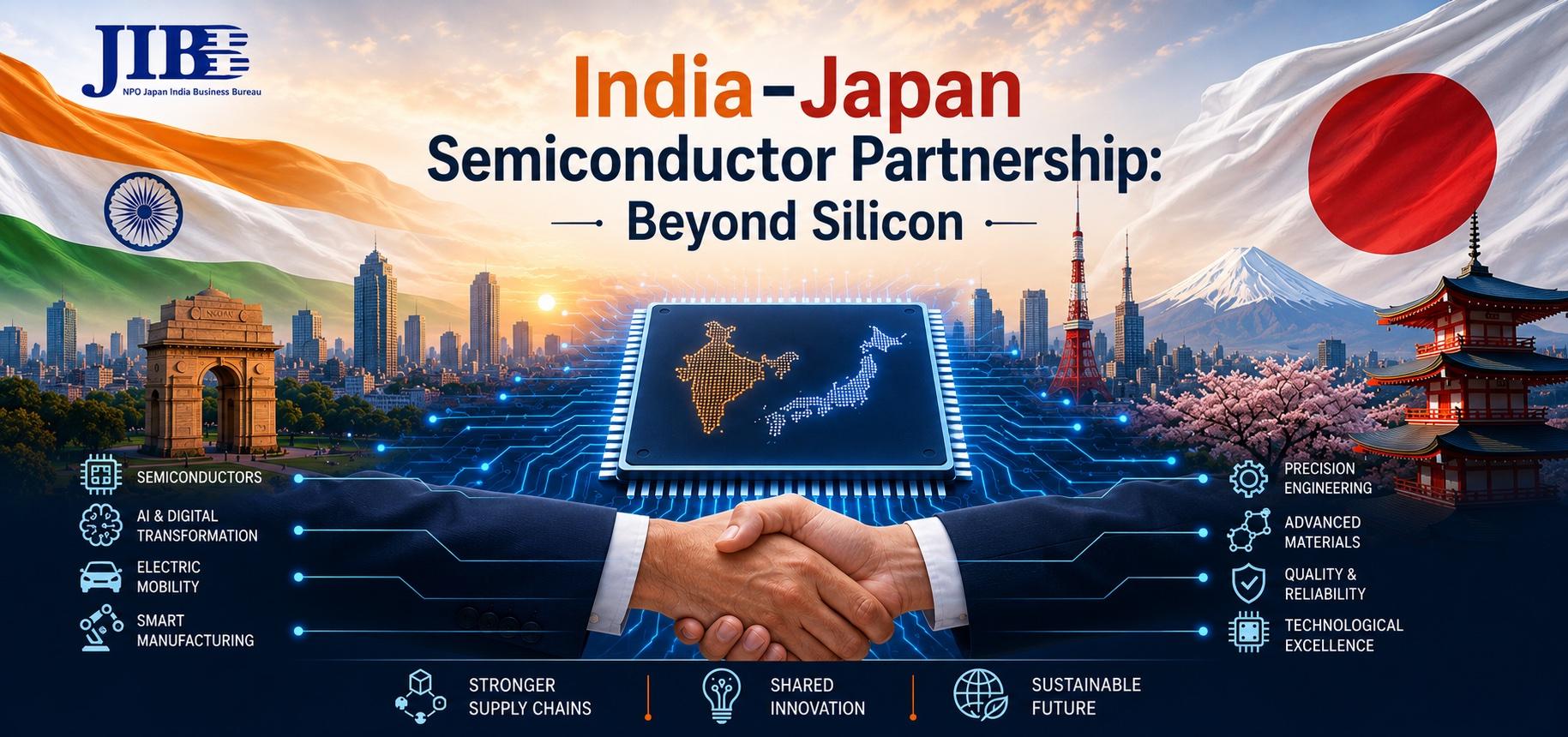
What Is the India-Japan Semiconductor Partnership?
India and Japan established the Japan-India Semiconductor Supply Chain Partnership through a Memorandum of Cooperation (MoC) signed in July 2023 between India's Ministry of Electronics and Information Technology (MeitY) and Japan's Ministry of Economy, Trade and Industry (METI). The government-to-government framework is complemented by industry-led initiatives such as the Japan-India Semiconductor Committee (JISC), which aims to connect Japanese semiconductor companies with India's growing semiconductor ecosystem.
The agreement aims to strengthen cooperation towards enhancing the semiconductor supply chain, with both government-to-government and business-to-business cooperation intended to advance resilient supply chains and leverage the complementary strengths of India and Japan. The MoC also provides a framework for mutually beneficial semiconductor-related business opportunities and partnerships between Indian and Japanese companies.
The India–Japan semiconductor partnership therefore carries real significance beyond the bilateral economic relationship. It demonstrates how complementary capabilities can strengthen global supply chains, accelerate innovation, and create a safer tech future. For a strategic overview of policy execution in action, see our analysis on Policy to Production.
This partnership can potentially be one of the cornerstones that defines the India-Japan strategic partnership in a fast-changing semiconductor landscape.
The one lesson the semiconductor shortage taught the world is that technological leadership is no longer just about innovation but resilience. Ever more, the design, manufacture, and supply of semiconductor chips has become a key aspect of economic competitiveness and national security.
For many nations who wish to shape the future rather than react to it, a strong semiconductor ecosystem is no longer desirable but imperative.
The Invisible Technology Behind Every Modern Revolution
What powers the modern world today?
At first glance, the answer is blatant. Cities are powered by electricity, the internet connects billions of people, and artificial intelligence (AI) is going to change the way in which we work, learn, and innovate. Yet at the heart of each one of these innovations is a chip so small that it fades into the background: semiconductor chips.
From when we unlock our smartphones or make a digital payment, to using GPS or asking an AI assistant questions, trillions of microscopic transistors process information silently in less than seconds.
Buried deep beneath the form factor of our pocket-based devices are semiconductor chips that form the backbone of both the digital economy, and what make healthcare, transportation, defence, manufacturing, and space exploration possible.
Semiconductors are not just important for consumer electronics. Inside a modern smartphone are specialised chips that help process information, handle security, enable wireless communication, and graphics.
Thousands of semiconductor components are used by electric vehicles that help in regulating battery performance. Hospitals rely on semiconductor-powered MRI scanners, CT imaging, and wearable health devices, while AI infrastructure and our data centres take advanced chips which can handle unimaginable volumes of information in moments.
Semiconductors are as central to the twenty-first century as energy resources were to twentieth-century industrial expansion.
Historically, nations competed for energy resources because they powered industrial growth. Today, they compete to bolster semiconductor supply chains since chips drive technology development and economic competitiveness.
It is no longer just the battle to produce electronic devices among countries in the world. It is about securing the technology behind every key innovation of our generation. Explore how this shift compares across sectors in Key Sectors.
Why Semiconductor Supply Chains Matter
Primarily hidden in the background, except when critical, semiconductors only came to global attention when COVID-19 revealed a weakness in the global semiconductor supply chain.
The world faced an unprecedented chip shortage as manufacturing slowed and international trade was disrupted. Production of automobiles came to a standstill, with consumer electronics and healthcare delayed for long periods of time due to missing semiconductor components.
A small chip was, therefore, the reason billion-dollar industries halted to a standstill.
The crisis marked a sea change in the way governments viewed semiconductors. They became key strategic resources essential to economic resilience, technological superiority, and national security.
Countries invested billions in semiconductor manufacturing, shoring up domestic semiconductor ecosystems and creating more secure supply chains.
The crisis also bore out a second truth: no nation can lead the semiconductor industry without the collaboration of every country together.
In fact, designing, manufacturing, testing, and packaging a chip requires a highly specialised global network of expertise, infrastructure, and materials.
Success comes through collaboration, not isolation.
Where India’s Semiconductor Ambition Meets Japan’s Expertise
India has recognized this shift with remarkable clarity.
India has been a centre for semiconductor design for decades, producing a disproportionate number of the world's semiconductor design engineers contributing to chips that are already used in smartphones, cloud computing, automotive systems, and industrial automation.
However today, India wants more than design.
The country is now building a whole semiconductor value-chain from fabrication to assembly, testing, packaging, and research through the India Semiconductor Mission (ISM) and the Semicon India Programme.
The Semicon India Programme was approved by the Union Cabinet on 15 December 2021 with an outlay of ₹76,000 crore and officially launched in January 2022 to support semiconductor manufacturing, display fabrication, chip design, packaging, testing, talent development, and research collaborations.
The goal is not simply to manufacture chips, but to strengthen India’s position in the global semiconductor industry while reducing dependence on external supply chains.
And that vision is already coming to fruition.
As of June 2026, 12 semiconductor projects worth around ₹1.64 lakh crore had been approved under the India Semiconductor Mission, including one silicon fab, one silicon-carbide fab, one integrated GaN Micro-LED display fab, and nine packaging units.
These investments are indicative of the rising confidence in India’s policy directions, its engineering talent, and long-term commitment towards advanced manufacturing. Read more on bilateral industrial synergies in the India-Japan Manufacturing Partnership.
More importantly, they symbolise India's transition from a predominantly software-driven technology economy toward a broader electronics and semiconductor manufacturing ecosystem.
Yet semiconductors remain one of the world’s most complex industries.
Manufacturing a single chip requires specialised equipment, ultra-pure materials, precision engineering, and decades of technical expertise.
No country currently dominates every segment of the semiconductor value chain independently.
Collaboration is therefore fundamental.
India Semiconductor Mission: Transition to Semicon 2.0
India's semiconductor strategy has entered an expanded second phase.
The Union Budget 2026–27 initially provided ₹1,000 crore for ISM 2.0 for FY 2026–27. Subsequently, in July 2026, the Union Cabinet approved Semicon 2.0 with a total budget outlay of ₹1,27,500 crore, marking a long-term policy commitment to establish a full-fledged semiconductor ecosystem in India.
Semicon 2.0 focuses on six strategic pillars: chip design, semiconductor equipment and materials manufacturing, additional fabs, strengthening ATMP/OSAT capabilities, research and development, and talent development.
This expanded policy is particularly significant for India-Japan semiconductor cooperation.
Japan's strengths in semiconductor equipment (~35% global market share), specialty materials (~50% market share in key categories), precision engineering, and industrial innovation complement India's growing semiconductor manufacturing, design, and talent ecosystem.
Semicon 2.0 therefore creates new areas where Indian and Japanese companies can work together across the semiconductor value chain.
Semicon 1.0 vs. Semicon 2.0 Focus Matrix
| Program Phase | Primary Focus Areas | Key Outlay & Targets | India-Japan Strategic Opportunity |
|---|---|---|---|
| Semicon 1.0 (Approved Dec 2021, Launched Jan 2022) | • Silicon Fabs & Display Fabs • Compound Semiconductors • Initial OSAT / ATMP Units • Chip Design Incentives (DLI) |
• Outlay: ₹76,000 Crore • 12 Approved Projects (~₹1.64 Lakh Cr) • Fabs & packaging units across India |
• OSAT partnerships (Renesas, CG Power, Stars Micro) • Initial equipment & tool procurement |
| Semicon 2.0 (Cabinet Approved July 2026) | • Semiconductor Equipment & Materials • Full-Stack Indian Semiconductor IP • Additional Fabs & Advanced OSAT • Advanced R&D & Skill Training Centers |
• Total Outlay: ₹1,27,500 Crore • 6-Pillar Comprehensive Ecosystem • Initial FY26–27 Budget Provision: ₹1,000 Cr • Specialized Talent & Equipment Hubs |
• Co-locating Japanese chemical & tool makers • R&D joint ventures & academic exchanges • Full-stack IP co-development |
The opportunity is no longer limited to semiconductor fabrication. It increasingly includes:
- Semiconductor manufacturing equipment
- Semiconductor materials
- Semiconductor design and intellectual property
- Assembly, packaging, and testing (OSAT/ATMP)
- Research and development
- Talent and skill development
- Supply-chain resilience
This broader ecosystem is where the India-Japan semiconductor partnership can generate long-term value.
Why Japan Matters to India’s Semiconductor Ecosystem
This is where Japan’s strengths become invaluable.
Though the bulk of media attention is focused on semiconductor fabrication, Japan holds a leading position in technologies that enable semiconductor manufacturing.
Advanced semiconductor manufacturing equipment, silicon wafers, and specialty materials used by chipmakers around the world are supplied by Japanese leaders such as Tokyo Electron, SCREEN Holdings, Shin-Etsu Chemical, and SUMCO.
We delve into this critical chemical and tool alignment in Precision, Purity, and Partnership: Crafting a Self-Reliant India-Japan Semiconductor Supply Chain.
Their sophistication has turned Japan into an important foundation of the global semiconductor supply chain, characterized by precision engineering, trustworthiness, and consistent advancement.
Japan's Semiconductor Strengths: Equipment, Materials and Precision Engineering
Semiconductor Manufacturing Equipment
Semiconductor manufacturing depends on highly specialised equipment used throughout the fabrication process.
Japanese companies command approximately 35% of the global semiconductor equipment market, making semiconductor tools an essential area of potential India-Japan cooperation under Semicon 2.0.
Semiconductor Materials
Semiconductor manufacturing requires highly controlled materials, including silicon wafers, photoresists, and specialty process chemicals.
Japan holds roughly 50% global market share in key semiconductor material categories, creating significant opportunities for cooperation as India develops its domestic semiconductor manufacturing base.
Precision Engineering
Manufacturing semiconductor devices requires precision engineering, advanced manufacturing capabilities, and consistent quality.
These are areas where Japan's decades of industrial expertise can complement India's growing manufacturing ambitions.
Research and Talent Development
Semiconductor innovation also depends on research, education, and skilled talent.
India and Japan are already exploring this area through institutional and industry collaboration.
Understanding the Semiconductor Value Chain
Chip making is about much more than silicon wafers or integrated circuits.
Design & IP → Materials & Equipment → Wafer Fabrication → Assembly & Packaging → Testing → System Integration
Detailed Value Chain & Bilateral Synergy
| Value Chain Stage | Key Technical Requirements | Leading Global Players / Dominance | India-Japan Synergy & Role |
|---|---|---|---|
| 1. Chip Design & IP | Architecture, EDA tools, VLSI engineering, System-on-Chip (SoC) | Qualcomm, AMD, NVIDIA, ARM, Renesas | India: ~19–20% of global semiconductor design engineers. Japan: Automotive & microcontroller IP. |
| 2. Materials & Chemicals | Photoresists, silicon wafers, ultra-pure gases & acids | Shin-Etsu, SUMCO, JSR, Sumitomo Chemical | Japan: ~50% global market share in key categories. India: Local supply base for upcoming fabs. |
| 3. Manufacturing Equipment | Coater/developer, etch, deposition, cleaning & testing systems | Tokyo Electron (TEL), SCREEN, ASML, Nikon | Japan: ~35% global machinery market share. India: Equipment localisation under Semicon 2.0. |
| 4. Wafer Fabrication | Cleanroom ops, front-end processing, node scaling | TSMC, Samsung, Intel, Tata Electronics | India: Dholera Fab & compound semiconductor fabs. Japan: Process optimization & yield management. |
| 5. Assembly & Packaging | OSAT / ATMP, flip-chip, 3D ICs, dicing & wire bonding | ASE, Amkor, CG Power, Renesas, Stars Micro, Kaynes, AOI | Bilateral: CG Power–Renesas–Stars Micro & Kaynes–AOI–Mitsui OSAT facilities. |
| 6. System Integration | Automotive electronics, industrial IoT, AI hardware | Sony, Panasonic, Tata Motors, Foxconn | India: Massive domestic consumer & EV market. Japan: World-class industrial quality standards. |
Each stage requires specialised expertise, infrastructure, technology and supply-chain relationships.
India is expanding its capabilities across this value chain, while Japan brings established expertise in areas such as semiconductor equipment, materials, precision engineering and manufacturing.
This creates opportunities for India-Japan collaboration across the semiconductor supply chain rather than in fabrication alone. Discover more on how this impacts global supply chains in Semiconductor Renaissance.
The semiconductor chain relies on an elaborate global web of researchers, manufacturers, policy makers, investors, and enterprises.
No nation can build a resilient semiconductor ecosystem in isolation.
Why India and Japan Are Natural Semiconductor Partners
India is not in competition with Japan; rather, they complement each other.
India offers rapid digital economy growth, a vast engineering talent pool, an impressively growing local electronics manufacturing base, and a substantial demographic dividend.
Decades of industrial expertise, leading-edge technology, and world-class manufacturing exist in Japan.
Together, they give rise to directions that no single country could ever achieve.
Comparative Capability Blueprint
| Semiconductor Capability | India's Profile & Strengths | Japan's Profile & Strengths | Strategic Bilateral Synergy |
|---|---|---|---|
| Semiconductor Design | Established capability (~19–20% of global design workforce) | Established capability (Automotive & Embedded LSI) | Co-creation: Japanese specs + Indian execution |
| Engineering Talent | Massive, young pool of STEM & VLSI graduates | Highly specialised industrial expertise; facing digital talent shortages | Addressing workforce needs through bilateral training & co-creation |
| Electronics Manufacturing | Rapidly expanding electronics & EMS hubs | Established, high-precision manufacturing base | Building resilient Asian manufacturing corridor |
| Semiconductor Equipment | Developing ecosystem targeted under Semicon 2.0 | World leader (~35% global market share) | Tool supply & local maintenance hubs in India |
| Semiconductor Materials | Developing ecosystem seeking domestic production | Global powerhouse (~50% share in key categories) | Chemical & wafer supply co-located near Indian fabs |
| Precision Engineering | Growing manufacturing & machining capabilities | Decades of unmatched precision standard | Quality control & advanced tooling transfer |
| Semiconductor Research | Expanding academic & institutional ecosystem (IITs/IISc) | Established university & corporate R&D labs | Joint research, IP creation, and faculty exchange |
| Semiconductor Manufacturing | Rapidly developing (Fabs & OSAT projects in progress) | Long-established industrial ecosystem & legacy fabs | Substrate, equipment & back-end tech collaboration |
Key India-Japan Semiconductor Collaborations
The India-Japan semiconductor partnership is moving beyond government-level intentions into business, research, and technology collaboration.
CG Power, Renesas, and Stars Microelectronics
CG Power and Industrial Solutions Limited, Japan's Renesas Electronics, and Thailand's Stars Microelectronics formed a joint venture to establish an Outsourced Semiconductor Assembly and Test (OSAT) facility in Sanand, Gujarat.
The project, approved by the Union Cabinet in February 2024, represents a direct connection between Japanese semiconductor expertise, Thai back-end experience, and India's growing semiconductor packaging ecosystem.
Renesas and IIT Hyderabad
In June 2024, Renesas Electronics and IIT Hyderabad entered into a three-year Memorandum of Understanding covering research and collaboration in VLSI and embedded semiconductor systems.
The collaboration aims to support innovation and talent development in India's semiconductor industry, including curriculum development, hands-on learning, academic interaction, and outreach programmes.
Tokyo Electron and Tata Electronics
In September 2024, Tokyo Electron (TEL) and Tata Electronics signed a strategic partnership to establish a semiconductor manufacturing ecosystem in India.
The MoU covers equipment infrastructure for Tata's Dholera fab and Jagiroad assembly/test facility, workforce training, process improvement, and R&D.
Mitsui, Kaynes Semicon and AOI Electronics
In March 2026, Mitsui & Co. announced a strategic business partnership with Kaynes Semicon and Japanese OSAT firm AOI Electronics to support the establishment of semiconductor back-end manufacturing in India.
The initiative aims to commence operations in the second half of 2026, focusing on OSAT processing with Mitsui providing raw-material procurement support, supplier collaboration, commercial sales support, and potential future investment.
These examples demonstrate that India-Japan semiconductor cooperation is actively developing across manufacturing, packaging, testing, research, and talent.
Japanese Semiconductor Companies and Their Role in India
Japan's contribution to India's semiconductor ecosystem extends across several parts of the value chain.
Major Japanese Industry Players & Ecosystem Alignment
| Japanese Company | Primary Sector & Capability | Strategic Role & Connection in India | Key Value Delivered |
|---|---|---|---|
| Renesas Electronics | Microcontrollers, Automotive SoCs & Power Devices | OSAT joint venture with CG Power & Stars Microelectronics; R&D partnership with IIT Hyderabad | Back-end manufacturing, automotive chip design & VLSI talent |
| Tokyo Electron (TEL) | Coater/developer, Etch, Deposition & Wafer-processing Equipment | Strategic partnership with Tata Electronics for Dholera Fab & Jagiroad facility | Advanced fab equipment supply, installation & maintenance |
| SCREEN Holdings | Single-wafer Cleaning & Track Systems | Critical partner in Japan's equipment ecosystem serving global fabs | High-purity cleaning systems for wafer processing |
| Shin-Etsu Chemical | Silicon Wafers & Photoresists | Global materials supplier evaluating Indian localisation | Ultra-pure chemical & wafer supply for domestic manufacturing |
| SUMCO | High-Purity Silicon Wafers (300mm / 200mm) | Core supplier of substrate material for front-end fabs | Base silicon supply for semiconductor fabrication |
| AOI Electronics | OSAT / Advanced Packaging & Back-End Testing | Partnership with Kaynes Semicon & Mitsui for Indian OSAT unit | Advanced IC packaging & testing technology transfer |
| Mitsui & Co. | Supply-Chain Support, Procurement & Trading | Commercial & supply-chain partner supporting Kaynes Semicon & AOI Electronics | Raw-material procurement, sales support & trade logistics |
The distinction between investment, technology partnerships, equipment supply, research collaboration, and manufacturing cooperation is important. Japanese companies can contribute to India's semiconductor ecosystem in different ways without every company being a direct semiconductor manufacturer in India.
Business Opportunities for Japanese Companies in India's Semiconductor Industry
The growing Indian semiconductor ecosystem creates opportunities beyond chip fabrication.
Semiconductor Manufacturing Equipment
As India develops semiconductor fabs and packaging facilities, demand for specialised manufacturing equipment and related technologies is expected to increase.
Japanese companies with expertise in semiconductor manufacturing equipment can potentially contribute to this expanding ecosystem.
Semiconductor Materials
The development of domestic semiconductor manufacturing also increases the importance of materials such as silicon wafers, photoresists, and specialty process chemicals.
Japan's expertise in semiconductor materials complements India's ambition to strengthen its semiconductor supply chain.
Semiconductor Packaging and Testing
India is building capabilities in assembly, testing, and packaging.
The growing OSAT ecosystem provides opportunities for Japanese companies with relevant manufacturing technology and experience.
Research and Development
India's engineering talent and expanding research ecosystem create opportunities for Japanese companies and institutions to establish collaborative R&D programmes.
Talent and Skill Development
Semiconductor manufacturing requires specialised skills.
Collaboration between Japanese companies, Indian universities, and research institutions can support curriculum development, practical training, internships, and technology development. For personalized advisory on expanding into India, explore JIBB Advisory Services.
Opportunities for Indian Companies
The India-Japan semiconductor relationship is not a one-way opportunity.
Indian companies can benefit from partnerships with Japanese businesses through:
- Technology collaboration
- Manufacturing partnerships
- Semiconductor equipment
- Materials and supply chains
- Research and development
- Engineering services
- Talent development
- Packaging and testing
- Industrial partnerships
India's youthful workforce, expanding digital economy, manufacturing ambitions, and growing semiconductor ecosystem complement Japan's technology, precision engineering, and industrial expertise.
Combined, they could form a semiconductor ecosystem which is highly competitive, resilient, and future-ready.
India-Japan Semiconductor Supply Chain
This partnership means so much more than just economics.
We will see continuing upward pressure on global demand for semiconductors as artificial intelligence, electric mobility, robotics, renewable energy, smart manufacturing, data centres, and future telecommunications technologies develop.
Consequently, the construction of resilient and diversified semiconductor supply chains has become an important strategic undertaking.
It is against the backdrop of a growing international renaissance in critical minerals, advanced manufacturing, and semiconductor supply chains that recent India-Japan cooperation signals a shared understanding that future technological leadership will hinge not just on innovation, but even more upon trust.
The Japan-India Semiconductor Supply Chain Partnership specifically recognises the importance of enhancing semiconductor supply-chain resilience and leveraging the complementary strengths of the two countries.
From Shared Vision to Shared Progress
Although governments set out intentions and industries commit billions to building semiconductor manufacturing, tangible progress relies on a less concrete but equally important factor: collaboration.
The semiconductor chain relies on an elaborate global web of researchers, manufacturers, policy makers, investors, and enterprises.
No nation can build a resilient semiconductor ecosystem in isolation.
That is where organisations come in to fill the gap, providing shared ground, expertise, and opportunities that make it easier for conversations to develop into real business partnerships.
One such platform is the Japan India Business Bureau (JIBB).
This initiative brings the two countries economically and technologically closer.
By serving as a network of networks, JIBB brings together stakeholders from government, academia, and business through industry forums and collaborative initiatives, creating opportunities for investment discussions, technology partnerships, and long-term business relationships. Learn more about joining our bilateral platform on the JIBB Membership Page.
Given the increasing importance of semiconductors to economic resilience and technological leadership, these engagements become increasingly important.
When leaders of industry, researchers, entrepreneurs, and policymakers sit together at discussions on semiconductor production as well as digital conversion and innovation, they are doing more than exchanging ideas.
They are shaping future industries.
Such collaborations stimulate joint research, technology partnerships, and enhanced business confidence in both countries.
The Future of India-Japan Semiconductor Cooperation
The timing could not be more significant.
India's semiconductor ecosystem is expanding while the country's semiconductor strategy is moving beyond manufacturing alone towards equipment, materials, intellectual property, research, talent, and resilient supply chains.
Long-term semiconductor demand is expected to remain supported by AI, data centres, automotive electronics, industrial automation, and other technology-intensive applications.
This presents India and Japan with a common opportunity as well as a challenge.
Japan has expertise in precision engineering, advanced materials, and industrial innovation, while India's youthful workforce, expanding digital economy, and manufacturing ambitions complement Japan's technology.
Combined, they could form a semiconductor ecosystem which is highly competitive, resilient, and future-ready.
Most importantly, their collaboration shows how technological powers are becoming less about individual national accomplishments and more about partnerships.
Chip making is about much more than silicon wafers or integrated circuits.
It is about creating an ecosystem which fosters innovation, where knowledge flows unhindered across borders and where global partnerships serve as the engines of sustainable growth.
In a more interconnected world with ever more advanced technologies, trust, collaboration, and long-term thinking will be the order of the day.
The rise of the India-Japan semiconductor partnership demonstrates a path for trusted cooperation to enhance global supply chains, boost innovation, and generate long-term technological gains.
In the coming years, this partnership can not only serve as an economic alliance, but as a best practice for how nations can build a more resilient, innovative, and connected future together.
Frequently Asked Questions
What is the India-Japan Semiconductor Supply Chain Partnership?
The Japan-India Semiconductor Supply Chain Partnership is a cooperation framework established through a Memorandum of Cooperation signed in July 2023 between India's Ministry of Electronics and Information Technology (MeitY) and Japan's Ministry of Economy, Trade and Industry (METI). It aims to strengthen cooperation towards enhancing the semiconductor supply chain and leverage the complementary strengths of India and Japan.
Why is Japan important to India's semiconductor industry?
Japan has decades of industrial expertise and holds leading global positions in semiconductor manufacturing equipment (~35% market share), silicon wafers and photoresists (~50% share in key categories), and precision engineering. These capabilities complement India's growing semiconductor manufacturing, engineering talent, and electronics ecosystem.
Why is India important to Japan's semiconductor industry?
India offers a large engineering talent pool (~19–20% of global design engineers), rapid digital economy growth, a growing electronics manufacturing base, and an expanding semiconductor ecosystem. This creates opportunities for Japanese companies across equipment, materials, manufacturing, packaging, testing, research, and talent development.
What is India's Semiconductor Mission?
The India Semiconductor Mission (ISM) is India's initiative to develop a robust semiconductor and display manufacturing ecosystem. The broader programme supports semiconductor fabs, compound semiconductor facilities, ATMP/OSAT facilities, chip design, and related ecosystem development.
What is Semicon 2.0?
Semicon 2.0 was approved by the Union Cabinet in July 2026 with a total budget outlay of ₹1,27,500 crore (building on an initial ₹1,000 crore budget provision in the Union Budget 2026–27). It focuses on semiconductor equipment and materials manufacturing, full-stack Indian IP, ATMP/OSAT expansion, R&D, and talent development.
Which Japanese semiconductor companies are involved in India?
Japanese companies involved in India's semiconductor ecosystem include Renesas Electronics, Tokyo Electron, SCREEN Holdings, Shin-Etsu Chemical, SUMCO, and AOI Electronics, while Japanese business group Mitsui & Co. provides supply-chain and commercial support. Their involvement spans manufacturing, equipment, packaging, testing, research, and business partnerships.
How is Renesas contributing to India's semiconductor ecosystem?
Renesas is involved in an OSAT joint venture in Sanand, Gujarat, alongside CG Power and Thailand's Stars Microelectronics. It has also collaborated with IIT Hyderabad on research and talent development in VLSI and embedded semiconductor systems.
What opportunities exist for Japanese semiconductor companies in India?
Opportunities exist across semiconductor manufacturing equipment, materials, packaging, testing, research and development, talent development, and broader supply-chain partnerships. India's expanding semiconductor ecosystem and Semicon 2.0 create additional opportunities in equipment, materials, intellectual property, and research.
How can Indian and Japanese companies collaborate in semiconductors?
Companies can collaborate through technology partnerships, manufacturing, equipment and materials supply, semiconductor packaging and testing, R&D, talent development, joint ventures, and broader supply-chain relationships.
What is the future of India-Japan semiconductor cooperation?
The future of the partnership extends beyond semiconductor fabrication. Cooperation can increasingly involve equipment, materials, packaging, testing, chip design, research, talent development, and resilient supply chains, allowing India and Japan to combine complementary strengths across the semiconductor value chain.