
Building the Policy Foundations for India-Japan Business Success
It's no longer a supply and demand world. Whether a business chooses to manufacture, produce, invent, scale or export hinges not just on the needs of the market, but also on government policy, the regulatory framework, the shape of trade deals, and the contours of bilateral cooperation. The understanding and adaptation of these policy landscapes isn't just a compliance function for businesses expanding into new markets—it is now a strategic success driver.
That's precisely the case for India and Japan. In just two decades, the relationship between India and Japan, underpinned by a shared commitment to economic resilience, innovation, trusted supply chains, and sustainable industry, has evolved into the India-Japan Special Strategic and Global Partnership.
Together, both nations have built an ecosystem in which governments, industries, research institutions, and the private sector collaborate to unlock long-term opportunities in areas ranging from manufacturing and digital technologies to clean energy, smart mobility, advanced electronics, semiconductors, and infrastructure.
Why Government Policy Matters for India-Japan Businesses
The rapidly changing policy ecosystem in India offers a landscape ripe with opportunity for Japanese companies considering the sub-continent as their next manufacturing base or investment destination. With ambitious government schemes such as Make in India, Digital India, the Production Linked Incentive (PLI) Scheme, PM Gati Shakti, and the National Single Window System (NSWS), alongside the India Semiconductor Mission, India's industrial sector is undergoing a rapid transformation.
India is simplifying processes, upgrading infrastructure, developing high-value manufacturing capabilities, and signaling to global investors that it is a competitive destination ready to be a partner of choice for industrial growth.
However, simply knowing these government programs exist isn't enough. Businesses need to understand practical compliance, market entry requirements, incentive accessibility, state-level policy variations, and the evolving bilateral engagement between India and Japan.
This is where institutional intermediaries play a crucial role. At the Japan India Business Bureau (JIBB), Government & Policy is an integral pillar enabling organizations to connect with institutions setting the framework for bilateral engagement. Through strategic interactions among government entities, industry associations, policy influencers, and private enterprises, our Government & Policy division equips your business with the confidence to tackle regulatory matters while leveraging national objectives of both countries.
From managing investments and navigating policy shifts to organizing government delegation visits and strengthening business dialogues, JIBB keeps enterprises informed, networked, and positioned for growth.
The Evolution of India-Japan Economic Cooperation
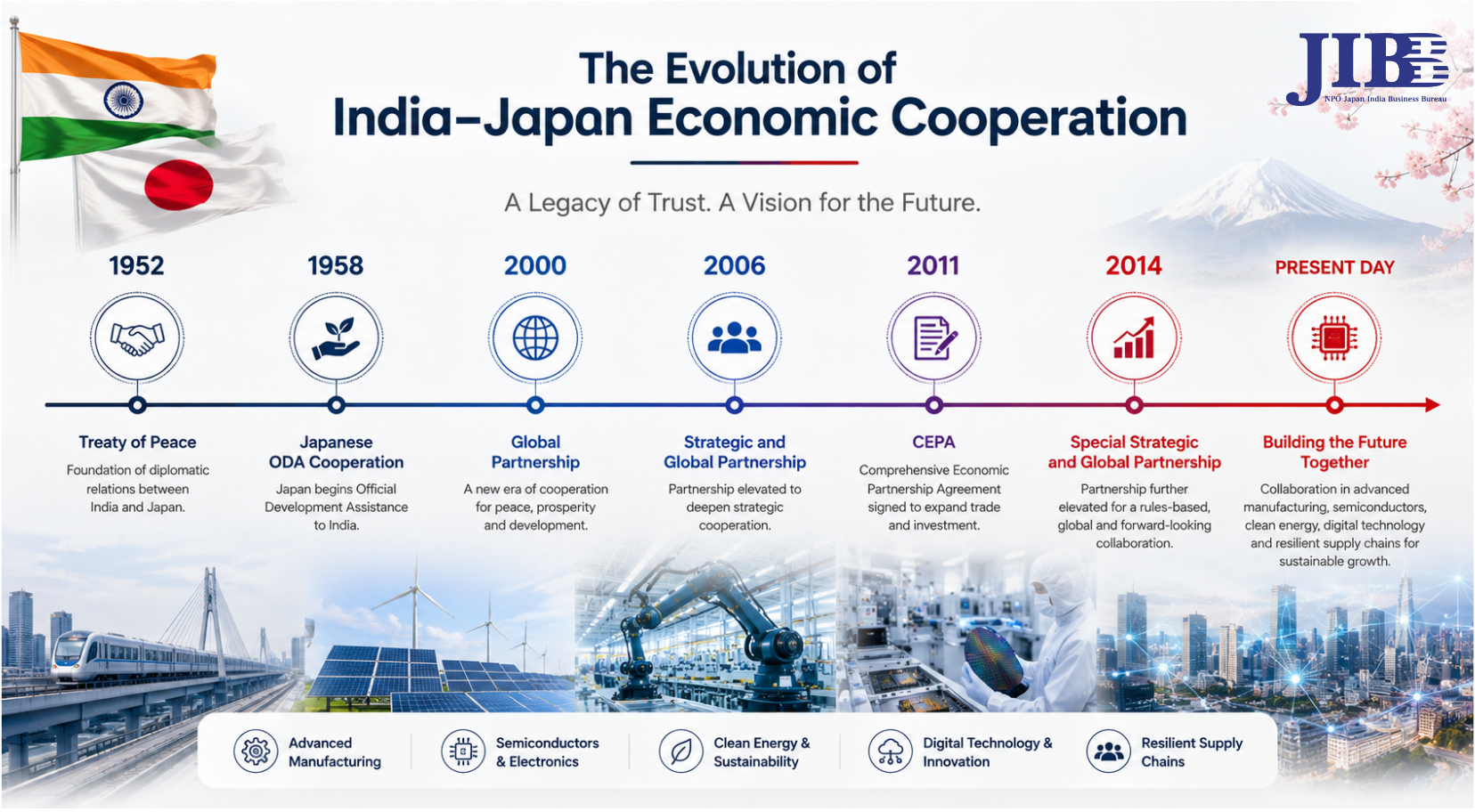
The robust strategic relationship that characterizes the India-Japan partnership today stands on a foundation of decades of mutual trust, policy coordination, and strategic collaboration. Diplomatic ties date back to the Treaty of Peace in 1952, and since then, the relationship has steadily deepened across economic, technological, and strategic dimensions. Starting in 1958, Japan has consistently been India's largest development partner via Official Development Assistance (ODA), contributing to key infrastructure projects from metro railways to dedicated freight corridors and smart cities.
Key Milestones in Bilateral Engagement
- 1952 — Treaty of Peace
- 1958 — Japanese ODA cooperation begins
- 2000 — Global Partnership established
- 2006 — Strategic and Global Partnership
- 2011 — Comprehensive Economic Partnership Agreement (CEPA)
- 2014 — Special Strategic and Global Partnership
- Current Phase — Advanced manufacturing, semiconductors, clean energy, resilient supply chains, and digital tech
Through the launch of the Global Partnership in 2000, its elevation to Strategic and Global Partnership in 2006, CEPA in 2011, and Special Strategic and Global Partnership in 2014, economic interdependence has reached new height. Trade, investments, technology transfer, and industrial opportunities continue to grow. Policy coordination now spans supply chain resilience, green transition and decarbonisation, digital revolution, startup ecosystems, and advanced R&D.
For a deeper dive into the geopolitical shift underpinning this economic trajectory, read our analysis on Beyond Diplomacy: India-Japan Transformation.
Key Indian Policies Relevant to Japanese Companies
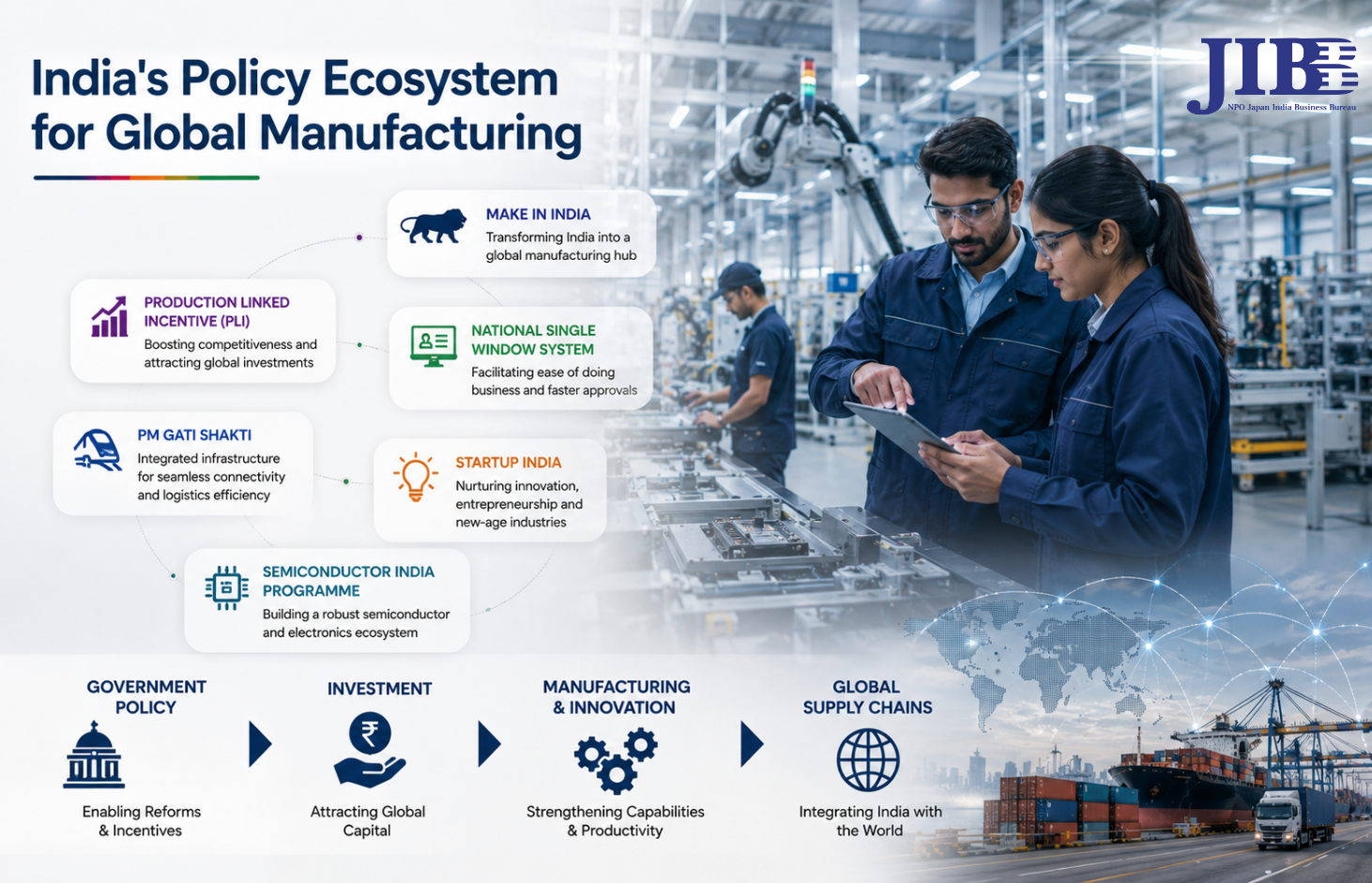
Beyond market size, India's rising stature as a top global investment destination stems from targeted reforms aimed at improving competitiveness, simplifying business operations, strengthening logistics, and encouraging value creation in tech-intensive manufacturing. Indian policy reforms create a stable environment for setting up factories, establishing R&D centers, and expanding participation in global supply chains.
Make in India: Strengthening Manufacturing Capabilities
Launched in 2014–2015, Make in India aimed to transform India from a consumer market into a global manufacturing powerhouse by encouraging indigenous production and attracting Foreign Direct Investment (FDI).
This initiative streamlines infrastructure development, logistics, and regulatory processes across an economy of over 1.4 billion people. For Japanese companies possessing core strengths in precision manufacturing, semiconductors, automotive engineering, and consumer electronics, Make in India provides a direct framework for long-term investments. This aligns directly with Japan's leadership in high-precision value creation and India's quest to become a preferred global manufacturer, as explored in our guide on the India-Japan Manufacturing Partnership.
Ease of Doing Business Through Digital Governance
Digitalization has fundamentally reshaped India's regulatory environment. Previously, securing clearances from multiple ministries added layers of administrative friction. Recent reforms focus on unified digital governance to boost transparency and speed.
- National Single Window System (NSWS): An integrated digital platform helping investors discover, apply for, and track clearances from central ministries, state departments, and municipal authorities through a single portal.
- India Industrial Land Bank (IILB): A GIS-enabled portal offering real-time data on industrial parks, land availability, utilities, connectivity, and zonal details, dramatically simplifying site selection for foreign investors.
Building Infrastructure for Industrial Growth
Modern manufacturing relies on seamless logistics. Under the PM Gati Shakti - National Master Plan, India has integrated multi-modal transport planning—spanning roads, railways, ports, aviation, inland waterways, and logistics nodes—under a unified GIS platform.
By eliminating inter-ministerial silos, PM Gati Shakti reduces transit times, lowers logistics costs, and optimizes cargo movement along Dedicated Freight Corridors (DFCs). For Japanese manufacturers operating just-in-time supply chains, this multi-modal integration delivers significant operational cost reductions and supply chain predictability.
Supporting Innovation, Entrepreneurship, and MSMEs
Recognizing that startups and Micro, Small and Medium Enterprises (MSMEs) drive industrial dynamism, the Indian government has introduced targeted support measures:
- Start-up India & MAARG Mentorship: Simplifies IP protection, compliance, and funding access while matching emerging ventures with veteran industry mentors.
- Udyam Registration Portal: Provides a fully digital, self-declaration system for MSME registration and official recognition.
- SAMADHAAN Portal: Accelerates the resolution of delayed payment disputes for smaller suppliers.
These reforms are particularly vital for the bilateral ecosystem. As identified in recent industry reports, promoting the entry of Japanese SMEs is a core pillar of the "India-Japan Industrial Competitiveness Partnership", prioritizing key sectors like automotive, electronics, clean energy, healthcare, defense, and semiconductors.
Recent state-level initiatives demonstrate how prefecture-to-state models enhance MSME entry, such as the ₹600 crore fund highlighted in the UP-Japan Investment Meet 2026.
Production Linked Incentives and Policy Implementation: Turning Vision into Investment
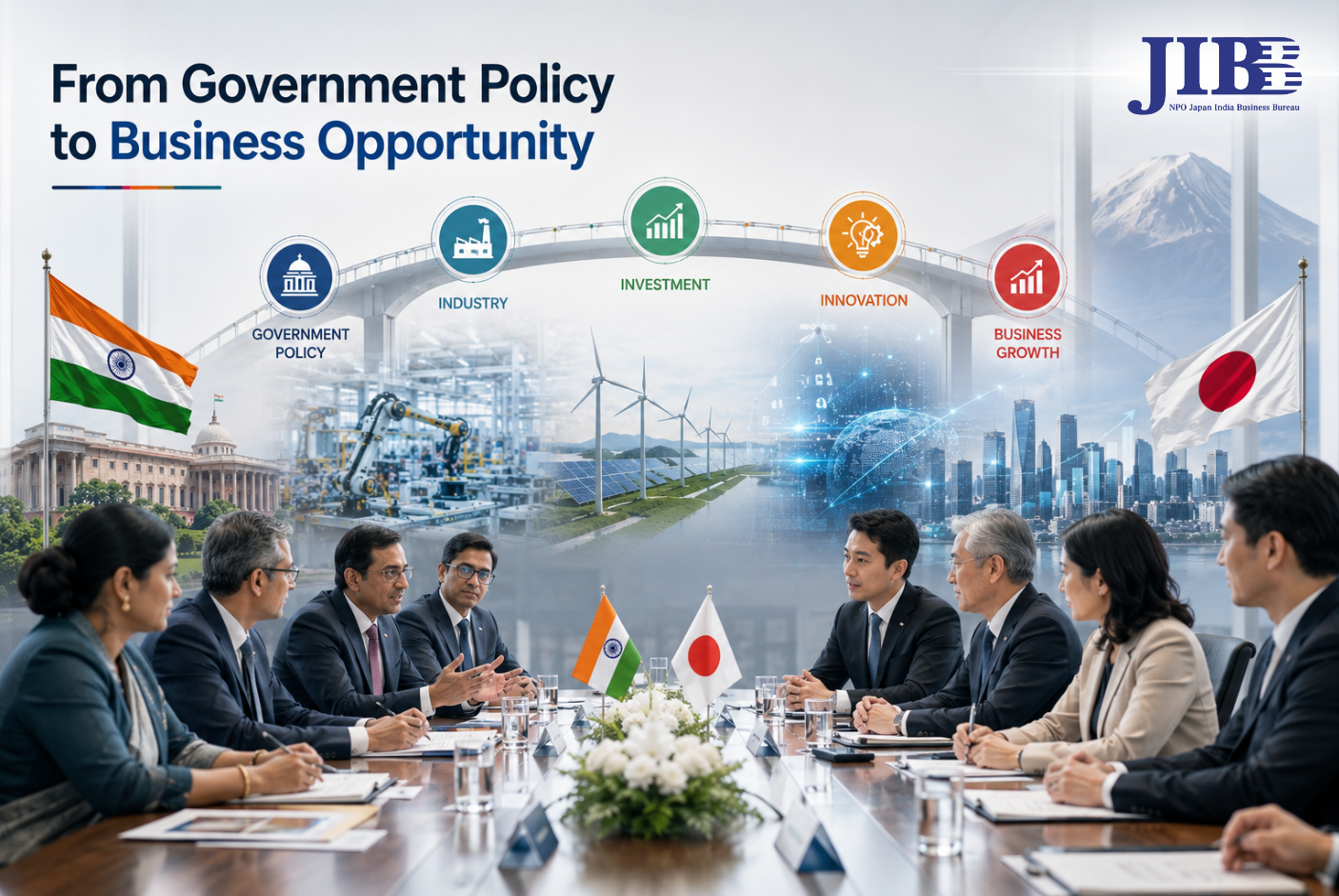
Strategic vision creates potential, but targeted fiscal incentives drive corporate execution. To convert investor interest into ground-level capital investment, the Indian government introduced the Production Linked Incentive (PLI) Scheme.
Understanding the Production Linked Incentive (PLI) Scheme
Launched in 2020, the PLI scheme enhances manufacturing competitiveness by providing performance-linked financial bonuses on incremental sales generated from domestic production. Rather than offering upfront static subsidies, PLI rewards performance, motivating long-term capacity expansion, technology transfer, and export orientation.
Currently spanning 14 strategic sectors—including electronics, semiconductors, telecom, pharmaceuticals, medical devices, auto components, solar PV modules, and advanced chemistry cell (ACC) batteries—the scheme has catalyzed billions in committed investments and created hundreds of thousands of jobs. For Japanese industry leaders in precision engineering and high-grade materials, PLI provides a lucrative pathway to scale India operations.
Strengthening the Electronics and Semiconductor Ecosystem

The transformation of India's electronics sector illustrates how policy levers accelerate industrial capability. Under the Semiconductor India Programme, backed by a landmark fiscal outlay, India is building end-to-end chip design, fabrication, assembly, testing, and packaging (ATMP/OSAT) capabilities.
- Scheme for Promotion of Manufacturing of Electronic Components and Semiconductors (SPECS): Offers capital expenditure reimbursements for units manufacturing electronic components, sub-assemblies, and specialized materials.
- Fiscal Support for Fab & Package Facilities: Provides up to 50% capital support on a pari-passu basis for semiconductor fabs, display fabs, and compound semiconductor facilities.
Japanese enterprises excel in critical semiconductor inputs—such as silicon wafers, photoresists, chemical mechanical polishing (CMP) slurries, stepper equipment, and precision robotics. As detailed in our feature India-Japan Semiconductor Partnership: Beyond Silicon, this policy alignment opens immense avenues for joint ventures, technology licensing, and R&D centers.
Beyond Incentives: Navigating Policy with Confidence
While incentive schemes offer compelling opportunities, commercial implementation requires navigating complex regulatory terrains:
- Sectoral eligibility and investment thresholds
- Tiered state vs. central incentive stacking
- Environmental clearances and land procurement
- Transfer pricing, GST, and customs duties
- Compliance audits and incentive disbursement documentation
Accessing government incentives effectively demands deep institutional knowledge. JIBB assists corporate leaders in evaluating scheme viability, aligning investment timelines, connecting with ministry secretariats, and managing end-to-end regulatory compliance.
Aligning National Priorities with Business Strategy
India's policies do not function in isolation; PLI, SEMICON India, Start-up India, and PM Gati Shakti form an interconnected ecosystem. Japanese companies that align corporate strategy with these national priorities unlock multiple advantages:
- Combining advanced Japanese process technology with Indian manufacturing scale.
- Participating in emerging domestic supplier networks and tier-1/tier-2 vendor development.
- Partnering with elite Indian universities and technical institutes for R&D.
- Utilizing India as an export hub serving global markets across EMEA and Southeast Asia.
Delegation, Bilateral Cooperation, and Policy Advocacy
Enduring partnerships extend beyond regulatory compliance. They thrive on continuous dialogue, institutional linkages, and mutual trust between public and private leadership.
Policy Dialogue Beyond Diplomacy
High-level ministerial contacts between India and Japan ensure that business priorities align with bilateral economic goals. Focus areas include economic security, clean tech, digital infrastructure, and supply chain diversification. This high-level commitment offers cross-border investors predictability and long-term stability.
Supporting Business Through Government Delegations
Government and trade delegations play a pivotal role in converting policy into operational ventures. Key delegation activities include:
- Business-to-Government (B2G) roundtables with ministry secretaries and chief ministers.
- Business-to-Business (B2B) match-making sessions with vetted local suppliers and distributors.
- Investment Roadshows highlighting regional industrial clusters.
- Site Visits to industrial parks, SEZs, and Dedicated Freight Corridor hubs.
- Technology Exchange Workshops uniting university researchers and corporate R&D heads.
Participation in structured delegations enables Japanese executives to build rapport with state investment promotion boards (such as Invest UP, MIDC, or iNDEXTb), accelerating land allotment and municipal approvals.
JIBB's Role in Facilitating Bilateral Engagement
As a premier institutional bridge, JIBB actively connects corporate enterprises with government counterparts across both nations. Our engagement model encompasses:
- Strategic government and trade delegation management
- Dedicated B2B business matching and supplier audits
- High-level policy consultations with central and state agencies
- PLI application and subsidy clearance support
- Cross-border technology transfer and R&D joint venture facilitation
Thought Leadership and Collaborative Advocacy
In a dynamic economic landscape, business leaders require proactive foresight. JIBB contributes to policy advocacy through executive roundtables, white papers, policy briefs, and industry forums. By working alongside ministries, industry associations (such as Keidanren, JETRO, FICCI, and CII), and academic bodies, JIBB amplifies the voice of industry to shape future policy frameworks.
Looking Ahead: Building the Next Chapter of India-Japan Cooperation
Government policy has evolved from a regulatory filter into a dynamic catalyst for industrial innovation and cross-border alliance. In a world defined by supply chain restructuring and technological evolution, countries offering sustained policy stability, transparent governance, and strategic vision will lead global industrial growth.
India's rapid policy evolution and digital infrastructure, paired with Japan's engineering mastery and capital depth, create an unmatched synergy. As both nations enter a new phase focused on value-driven growth and supply chain resilience, Japanese enterprises will find in India not just a market, but a competitive global manufacturing base.
At JIBB, we remain committed to bridging policy vision with commercial success—turning government frameworks into long-term enterprise growth.
Frequently Asked Questions
What is the India-Japan Special Strategic and Global Partnership?
The India-Japan Special Strategic and Global Partnership is the bilateral framework encapsulating the strategic relationship between both nations, promoting cooperation across economic growth, technology, infrastructure, trade, and regional supply chain resilience.
Why is India an important investment destination for Japanese companies?
India offers a rapidly expanding market, massive demographic dividend, skilled workforce, rapidly upgrading logistics infrastructure, and proactive industrial policies designed to support global manufacturing hubs.
Which Indian government policies are most relevant to Japanese manufacturers?
Key policies include Make in India, the Production Linked Incentive (PLI) Scheme, SEMICON India Program, PM Gati Shakti National Master Plan, and National Single Window System (NSWS).
Can Japanese companies benefit from the Production Linked Incentive (PLI) Scheme?
Yes, Japanese companies in eligible sectors such as electronics, semiconductors, auto components, medical devices, and clean tech can leverage performance-linked financial incentives based on incremental sales and production capacity.
What is the India Semiconductor Mission and why is it relevant to Japanese companies?
The India Semiconductor Mission (ISM) provides fiscal support for building semiconductor ecosystems in India. Japanese companies specializing in semiconductor materials, equipment, testing, packaging, and chemical supplies have vast opportunities for joint ventures and expansion.
What is the National Single Window System (NSWS)?
NSWS is an integrated digital governance portal enabling investors to identify, apply for, and track essential central and state clearances and approvals required for business setup in India.
Do Indian states offer separate investment incentives?
Yes, individual Indian states offer specific industrial, land, tax, and power subsidies alongside central government policies. Success requires aligning both state and central incentive structures.
How can Japanese SMEs enter the Indian market?
Japanese SMEs can enter via joint ventures with local partners, vendor/supplier partnerships with prime manufacturers, establishing local subsidiaries, or leveraging specialized MSME funds and industrial parks like YEIDA Japan City.
What role do government and business delegations play in India-Japan cooperation?
Delegations facilitate direct B2G roundtables, B2B networking, industrial site visits, and policy advocacy, helping transform high-level MOUs into operational commercial projects.
How does JIBB support India-Japan business and policy engagement?
JIBB provides advisory support, delegation management, institutional matchmaking, PLI navigation, regulatory compliance, and thought leadership to connect corporate strategies with government frameworks.
To discuss your enterprise's India-Japan expansion strategy, schedule a consultation on our Membership Page or reach out directly via our Contact Page.